
Two inks are described as “environmentally friendly”, but one description discusses renewable raw materials while the other focuses on energy use. Which is better suited to your job? The product name alone cannot answer that question. Choosing a sustainable printing ink means understanding what was measured, which product the evidence covers and what the findings mean under real printing conditions.
Turn a broad claim into a question you can check
The “Sustainable Raw Materials” report in the July 2026 issue of Ink World shows an industry discussion moving towards clearer evidence. Suppliers are considering carbon-footprint data, recyclability and performance together. The report interviews several suppliers; it is neither a ranking of inks nor an endorsement of all their claims. Ink World report, publicly republished by Arkema
For a print shop, the starting question is: “Which part of this job do we want to improve?” Reducing waste, choosing renewable raw materials and demonstrating deinkability are three different goals. Define the goal before comparing options so that the documents and tests answer the same question.
Bio-based, biodegradable and compostable are different terms
“Bio-based” refers to the biological origin of some of the materials. “Biodegradability” concerns breakdown under defined conditions, while “compostability” has its own criteria and test conditions. The European Printing Ink Association, EuPIA, cautions that these terms are sometimes used interchangeably and that environmental claims need scientific support. EuPIA product-stewardship guidance
Vegetable oil in a formulation therefore does not answer every environmental question. Ask the supplier to identify the component, its proportion and the product covered by the claim. If a customer wants a particular statement printed on packaging, review the exact wording alongside the evidence. A general word such as “green” cannot replace a traceable explanation.
Compare carbon footprints within the same boundaries
The Ink World report discusses a product carbon footprint, or PCF, as greenhouse-gas emissions within a specified life-cycle boundary. A life-cycle assessment, or LCA, examines a wider range of environmental impacts. The two terms therefore do not describe the same report. Ink World
Our practical suggestion is to list the unit, data year and stages covered before comparing two figures. Do not directly compare a figure for producing one kilogram of ink with a figure for one thousand printed copies. Ask the report provider whether paper use, printing energy and waste are included. Without that context, a number is an inadequate basis for deciding on a print job.
Paper recycling depends on the printed combination
In printed-paper recycling, “deinking” concerns removing ink during the recycling process. INGEDE explains that assessment depends on the ink-and-paper combination: a result cannot simply be transferred from one paper grade to another without checking. It identifies INGEDE Method 11 for assessing the deinkability of printed products. INGEDE on ecolabels and test methods
If your books, magazines or brochures are printed on both coated and uncoated paper, ask about each combination separately. Request the exact paper, ink, coating and tested sample identified in the report. Do not present the recyclability of unprinted paper as evidence for the finished product. Acceptance criteria should relate to the construction actually delivered to the customer.
What does a supply-chain certificate actually confirm?
Some product descriptions refer to mass balance. ISCC explains that certified and non-certified materials can be physically mixed under this approach, while verifiable accounting tracks quantities and the attribution of their characteristics. This should not be confused with complete physical segregation of the materials. Official ISCC explanation
When reviewing such documentation, check the certificate holder, its scope and the permitted product claim. If a claim relies on mass-balance attribution, that basis should remain clear in the purchasing description. A supply-chain certificate does not automatically establish approval for every printing application.
Assess press performance on the actual job
Environmental documentation does not replace a print trial. Prepare an assessment sheet for the real job: record the substrate, press, associated consumables, colour reference and finishing stages. Define success before starting so that the evaluation does not depend only on a general impression afterwards.
For a brochure, for example, you could record the match to the approved colour sample, the time taken to reach acceptable production conditions and the sample’s condition after folding and binding. When comparing two inks, log setting changes and avoid changing several factors simultaneously without a reason. This trial plan is an editorial suggestion for organising a comparison; technical limits should be agreed with the supplier and production manager.
Bring these documents and answers together before buying
- The exact claim: What is the intended benefit, and which product or characteristic does it concern?
- Product details: What are the exact name and code, technical-data-sheet version and recommended application conditions?
- Supporting evidence: What scope, date and limitations apply to the test report or certificate?
- Comparability: Are the figures for both options expressed using the same units and boundaries?
- Fit with the job: Has the actual combination of paper, ink and finishing been considered?
- Production outcome: How have the acceptable sample, observations and setting changes been recorded?
Create a short comparison file for each option. If a document is unavailable, mark the field “not supplied”; do not treat its absence as a definitive positive or negative result. For a claim you intend to pass on to a customer, ask for a written, traceable answer.
Explain the job requirements clearly
An informed ink choice brings together three things: the job requirements, relevant documentation and an actual trial result. A product may suit one criterion while requiring more evidence for another. Precise questions make the technical discussion more useful.
To discuss the available options with Iran Shoraka’s team, specify the printing process, paper or substrate, finishing stages and the customer’s environmental requirement. This article does not attribute any specific environmental certification or claim to Iran Shoraka products. Check each product’s information against its own documentation.
Printing inks and printroom products · Choosing sheetfed offset ink · The role of resin in printing ink — Persian · Technical advice
Sources and further reading
1. Kerry Pianoforte, “Sustainable Raw Materials”, Ink World, July 2026, pages 12–13; public reprint published by Arkema.
2. EuPIA, Product Stewardship: sustainability and environmental terminology.
3. INGEDE, Ecolabels and Methods: assessing deinkability.
4. ISCC, Mass Balance and Attribution: Understanding the Difference, 13 February 2026.
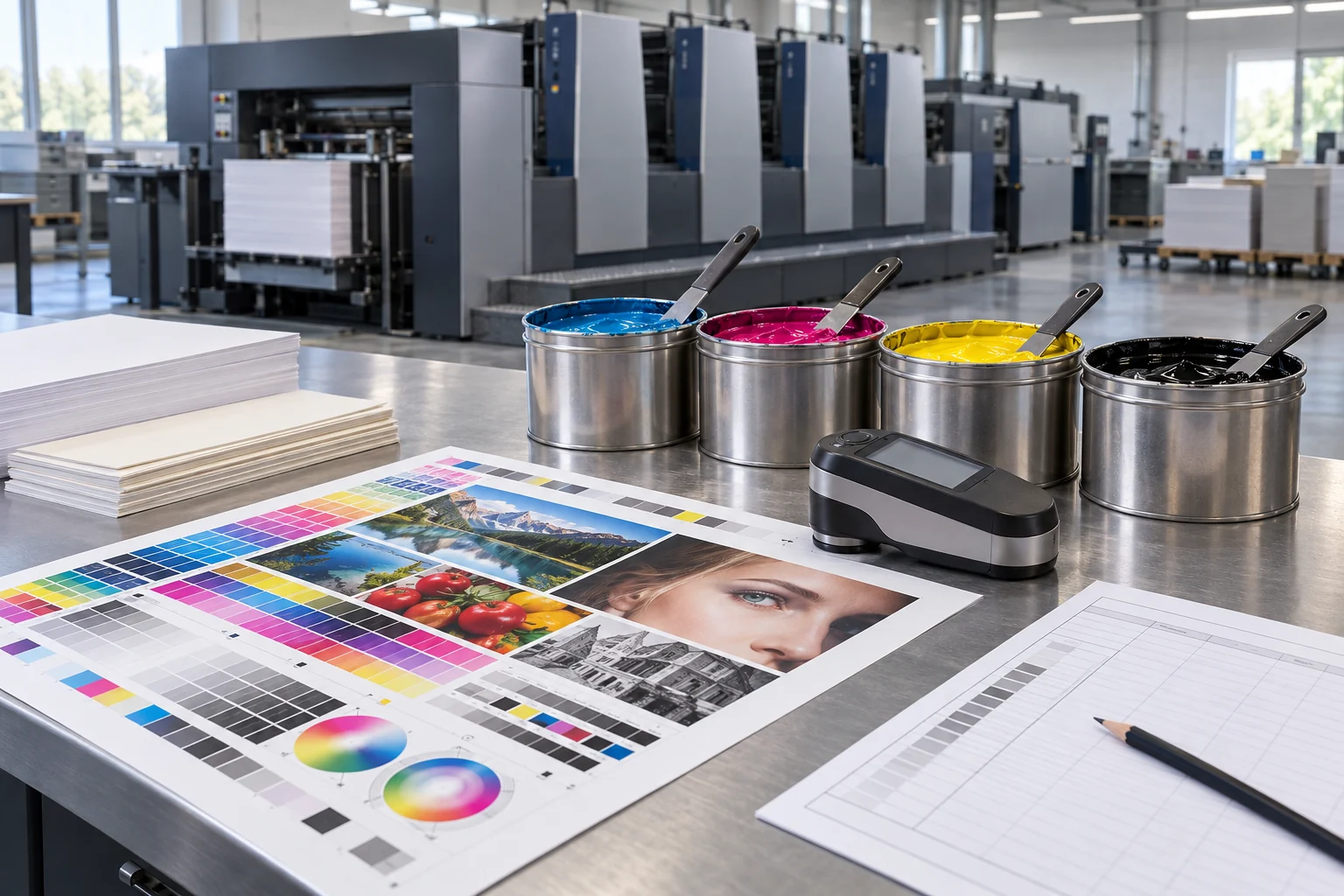
Editorial note: This educational article was prepared with AI assistance using the sources above. The checklist and comparison example are editorial suggestions, not product-test data. The accompanying image is an AI-generated illustration and does not document Iran Shoraka’s premises or equipment.